 TREE KING
Tree care tips
How to Prepare Your Trees for Hurricane Season in Fulshear & Katy
Hurricane season runs June 1 to November 30. The trees that fail in storms are usually the ones that were already weak — and most of those warning signs are visible now.
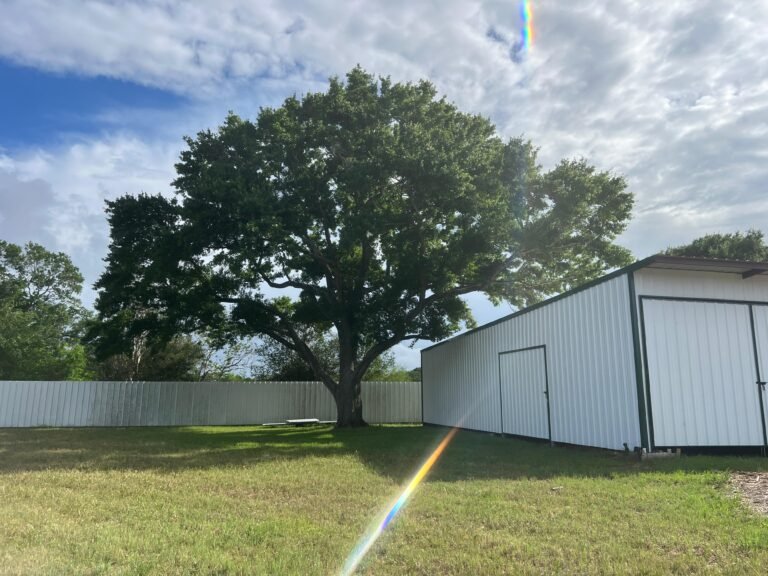
Walk your yard and look for these
Dead limbs — no leaves in summer, bark peeling off. They're the first things to fly in high wind.
Cracks and splits — especially where two big trunks meet in a tight "V".
Leaning trees — particularly a new lean, or soil cracking and lifting on the opposite side.
Mushrooms or conks at the base or on roots — a sign of internal decay.
Heavy limbs over the roof — even healthy limbs can break under hurricane winds.
Recently disturbed roots — trenching, new driveways, or grade changes weaken anchorage.
What a pre-storm trim does
A good crown cleaning removes dead and weak wood. Careful thinning lets wind pass through the canopy instead of catching it like a sail. Clearance pruning keeps limbs off the roof. What it should not do is strip out the inside of the tree or top it — both make trees weaker, not stronger.
Do this in spring or early summer so you're ready before the peak of the season in August and September. For oaks, see the best time to trim oak trees in Texas.
After the storm
Stay away from downed lines and treat every wire as live. Photograph damage before anything is moved for your insurance claim. Watch out for broken limbs still hanging in the canopy. And hire a local, insured company with a real address — not a crew knocking on doors who'll be gone next week.
Tree King handles storm damage cleanup and emergency tree removal across Weston Lakes, Fulshear and Katy. Call 361-850-3643.
Which trees hold up best in hurricanes
Studies of tree damage after Gulf Coast hurricanes have found big differences between species. Live oaks, bald cypress, southern magnolias and crape myrtles were among the most wind-resistant. Water oaks, laurel oaks, pecans, Bradford pears and pines failed more often, by snapping, dropping large limbs or uprooting.
Structure matters as much as species. A tree with one strong trunk and well-spaced limbs does far better than one with two trunks squeezed together in a tight V. That is the reason to shape young live oaks early: the structure you set in the first few years is the structure that meets the storm twenty years later.
A simple timeline
- Winter: have large oaks pruned in the safe window for oak wilt, and get a diagnostic on any tree you are unsure about.
- Spring: walk the yard, prune non-oak trees, and loosen or remove stakes and straps on young trees so the trunks can strengthen.
- July: oak pruning can resume. This is the last comfortable month to get work done before the August and September peak.
- When a storm is named: do not start heavy pruning. Brush left at the curb becomes flying debris. Move vehicles away from large trees and take photos of your trees and roof for your records.
Young trees need attention too
A newly planted tree is top-heavy with a small root ball. Check that it is not planted too deep, that the mulch is off the trunk, and that any stakes hold it loosely enough to sway. A trunk that can move a little grows stronger than one held rigid.
Common questions
Should I thin my trees before a hurricane?
Removing dead and weak wood and lightly thinning the outer canopy helps. Heavy thinning, topping and stripping the inside of the limbs do the opposite and make the tree more likely to fail.
Does topping a tree make it safer in a storm?
No. Topping removes the tree's structure, causes weak fast-growing sprouts and opens large wounds to decay. A topped tree is more dangerous a few years later, not less.
Which trees are most likely to fall in a hurricane?
Trees with dead limbs, trunk decay, damaged roots or two trunks joined in a tight V. By species, water oaks, laurel oaks, pecans, Bradford pears and pines have failed more often in Gulf Coast storms than live oaks, bald cypress and magnolias.
Ready to get started?
Call Tree King for an upfront, on-site estimate. We'll tell you exactly what your trees need — and what they don't.